Free Guide: Local vs. Regional vs. OTR – Choosing the Right Trucking Career Path
Jump to Section
Understanding the Trucking Landscape
Entering the world of commercial driving is one of the most stable career moves a person can make. However, "trucking" isn't a single job—it is a massive industry with vastly different lifestyles depending on the routes you choose. The three primary categories are Local, Regional, and OTR (Over-the-Road).
Choosing the wrong path can lead to quick burnout, while the right path can provide a fulfilling career with the perfect balance of income and personal time. This guide breaks down exactly what you can expect from each, helping you navigate the road ahead with confidence.
Local Trucking: Home Every Night
Local trucking is often the "holy grail" for drivers with families or those who value a routine. As a local driver, you typically operate within a 100-to-200-mile radius of your home terminal. You start your shift in the morning and end it in the evening, sleeping in your own bed every night.
Common Roles: Local roles include food service delivery (Sysco, US Foods), beverage delivery (Pepsi, Budweiser), construction hauling (dump trucks, cement mixers), and LTL (Less-Than-Truckload) P&D (Pick-up and Delivery) routes.
The Trade-off: While you get daily home time, local trucking is often physically demanding. You may be required to unload your own trailer using a lift gate and a hand truck, navigate tight city streets, and make 15-20 stops per day. Pay is usually hourly rather than by the mile.
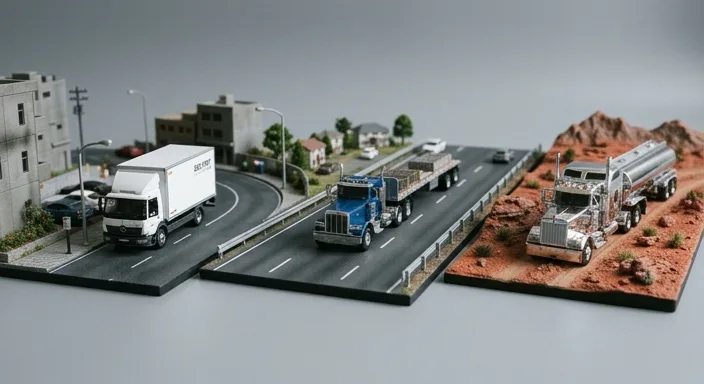
Regional Trucking: The Middle Ground
Regional trucking strikes a balance between the high mileage of OTR and the home time of local work. Regional drivers usually stay within a specific geographic area, such as the Northeast, the Midwest, or a cluster of 3-5 states.
Home Time: Most regional drivers are out for 5 days and home for 2 (the standard weekend). Some "hub-and-spoke" regional jobs might even get you home once or twice during the middle of the week.
The Work: You will likely drive a tractor with a sleeper berth, but you won't live in it for weeks at a time. The driving is usually more consistent than local work, with fewer stops and more "no-touch" freight, meaning you just drop and hook trailers without manual labor.
OTR (Over-the-Road): The Long Haul Lifestyle
OTR is the quintessential image of trucking. These drivers are the backbone of the interstate commerce system, hauling freight across the entire country (and sometimes into Canada or Mexico). If you want to see the Grand Canyon, the Florida coast, and the Pacific Northwest all in one month, OTR is for you.
Lifestyle: You will live in your truck for 2 to 4 weeks at a time. Your truck is your home, equipped with a bed, refrigerator, and often a microwave or television. You will shower at truck stops and manage your life from the cab of a Class 8 vehicle.
Pay: OTR usually pays the most in terms of gross annual income because you are racking up the highest number of miles. Pay is almost always calculated as Cents Per Mile (CPM). The more you drive, the more you earn.
Side-by-Side Comparison
To help you visualize the differences, here is a breakdown of the key metrics for each path:
- Local:
- Pay: $20 - $35 per hour.
- Home Time: Daily.
- Physicality: High (loading/unloading).
- Regional:
- Pay: $60k - $85k per year (mix of CPM and bonuses).
- Home Time: Weekends/Every 5-7 days.
- Physicality: Moderate (mostly drop and hook).
- OTR:
- Pay: $70k - $100k+ per year (CPM based).
- Home Time: Every 2-4 weeks.
- Physicality: Low (mostly highway driving).
Factors for Choosing Your Path
Before signing with a carrier, ask yourself these three critical questions:
1. What are your family obligations? If you have young children or a spouse who needs you home, local is the only sustainable option. If you are single or have an empty nest, OTR offers the highest earning potential and lowest living expenses (since you live in the truck).
2. How do you handle physical labor? Local jobs are "labor" jobs that involve driving. OTR jobs are "driving" jobs that involve sitting. If you have back issues, the constant loading of local delivery might be too much. Conversely, if you hate sitting for 11 hours straight, OTR will be a struggle.
3. What is your tolerance for city driving? Local drivers must be masters of backing into tight alleys and navigating traffic. OTR drivers spend 90% of their time on open interstates with cruise control engaged.
Frequently Asked Questions
Do I need a different CDL for OTR vs Local?
No. A standard Class A CDL allows you to drive both OTR and Local. However, local jobs often require extra endorsements like Tanker or Hazmat depending on the cargo.
Can I start in Local trucking as a new driver?
Historically, local companies wanted 1-2 years of OTR experience. However, due to the driver shortage, many local LTL and food service companies are now hiring students straight out of CDL school.
Which path pays the most?
Generally, OTR has the highest ceiling because of the sheer volume of miles. However, high-end local specialized roles (like fuel hauling) can actually outearn many OTR drivers.